


New Delhi: A big update has come out regarding the country’s much awaited Bullet Train. Railway Minister Ashwini Vaishnav had hinted about this on Thursday. He had said that there is a possibility of getting the first bullet train on August 15, 2027.
The Railway Minister had said that the country will see its first bullet train running on the tracks next year. Once operational, the Mumbai-Ahmedabad Bullet Train will transform intercity travel by providing fast, reliable and affordable mobility to the middle class. It will cover the distance of about two hours at low fare.
Union Railway Minister Ashwini Vaishnav said on Friday that the work on the Bullet Train project is going on at a fast pace. This project will be completed by 2027. He said that with the construction of Mountain Tunnel-5 in Palghar, the project has achieved another milestone today. The Railway Minister said that there are a total of 7 mountain tunnels and one undersea tunnel in the project.
Railway Minister Ashwini Vaishnav said that Bullet trains will be back on track by 2027. Its first section will be opened from Surat to Bilimora. The second section will start from Vapi to Surat, then from Vapi to Ahmedabad, then from Thane to Ahmedabad and finally from Mumbai to Ahmedabad.
Describing about the Bullet Train Project, Vaishnav further said that a new type of technology has been used to install the pole, in which the pole is lifted from the ground and taken to the viaduct. This technology has been developed in India. Now Japan will also use it in its projects.
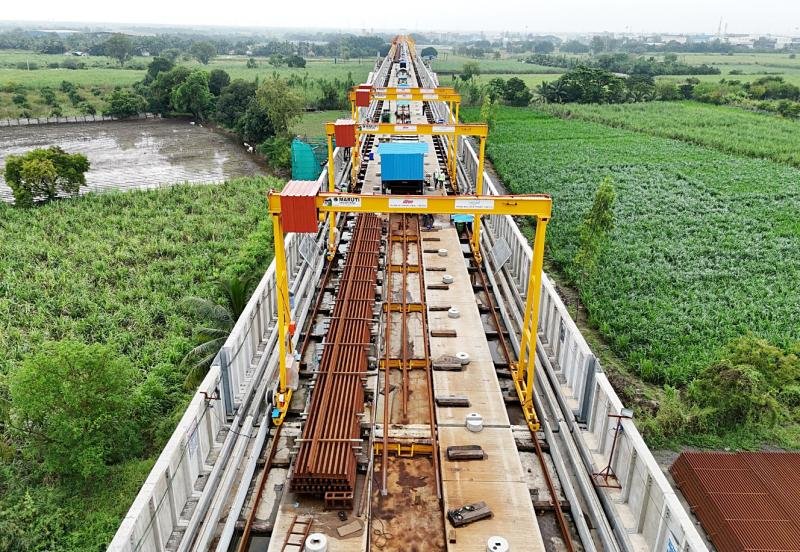
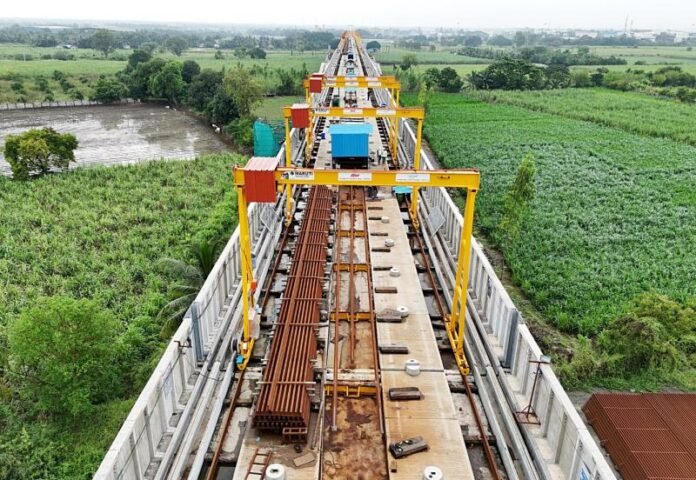
The Union Minister further told about the new technology of the track system that he has found a very good innovation for J-Slab. This is the structure on which the track is laid. Vaishnav said that, this slab is prepared in the factory, brought to the site, and then laid one by one using machines.
Bullet train has 12 stations in Maharashtra, Mumbai, Thane, Virar and Boisar. Vapi, Bilimora, Surat, Bharuch, Vadodara, Anand, Ahmedabad and Sabarmati in Gujarat. However, Sabarmati and Mumbai are terminal stations. Mumbai station is in BKC (Bandra-Kurla Complex), and three depots have been built.
Construction of second tunnel in Maharashtra
One of the longest tunnels in Palghar district, the 1.5 km Hill Tunnel is between Virar and Boisar bullet train stations. The first 5 km underground tunnel between Thane and BKC was completed in September last year.
Total length of project
The total length of the project is 508 kilometers and the length of the tunnel is 27.4 kilometers. Out of this, 21 km is underground tunnel and 6.4 km is surface tunnel. There are total 8 mountain tunnels. Out of which 7 are 6.05 kilometer tunnels in Maharashtra and one is 350 meter tunnel in Gujarat.
transportation landscape
Making its way through densely populated cities, rugged terrain and protected wildlife sanctuaries, the Mumbai-Ahmedabad Bullet Train Project faces one of the toughest engineering challenges ever seen in the country.
Yet, with each milestone achieved, the high-speed rail corridor is moving closer to reality; once completed, the project will be a game-changer in India’s transportation landscape. Construction work is gaining momentum in the entire corridor. Geotechnical investigations are nearing completion, work on strategically important mountain tunnels has begun, and open foundation work for approximately 11 kilometers of piers has been completed.
noise barrier
As the corridor is being built, attention is also being given to the communities living along its route. Union Minister Ashwini Vaishnav further said that, to reduce the noise caused by train movement, the High-Speed Rail Corporation has started installing noise barriers on both sides of the viaduct.
Using Shinkansen technology, these noise barriers consist of specially engineered concrete panels designed to absorb and deflect sound, he said. Each panel rises two meters above rail level and is one meter wide, creating a continuous acoustic shield along the elevated corridor. Once installed, these barriers are expected to significantly reduce operational noise from both trains and supporting civil structures, helping to ensure a quiet environment for nearby residents.