

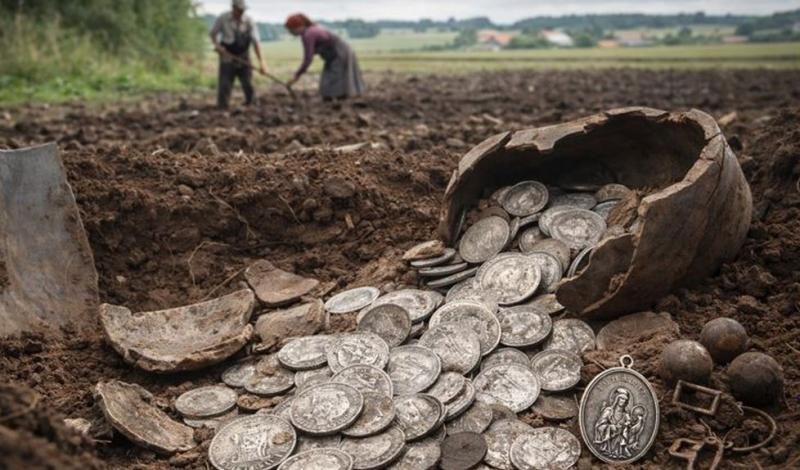

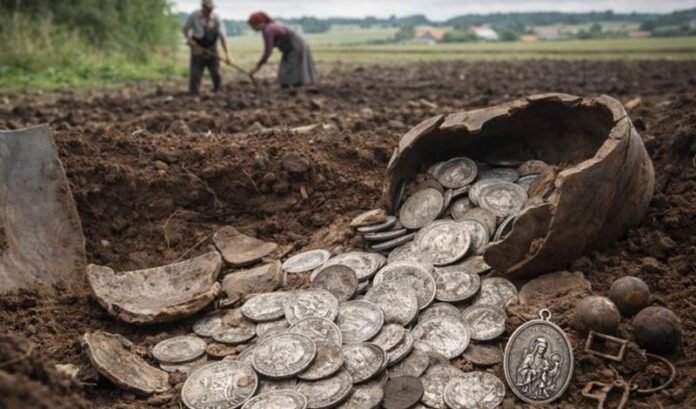
WarsawWarsaw. A historical mystery has come to light during plowing in the fields of Bukovitsa Wielki, a village in the northern part of Poland, which has shocked scientists. This mystery that came to light revealed the layers of the centuries-old past. When a farmer couple was shoveling stones to remove stones from their field, they were startled by something shining silver from under the soil. Within a short time it became clear that this was no ordinary find, but a complete treasure of the 17th century. The discovery took place in the Warmian-Masurian region of Poland, where no major historical site had ever been found. A treasure of 162 silver coins, about 350 years old, was buried under the ground. Looking at the coins, experts estimated that the treasure dates back to between 1660 and 1679, a period when the Commonwealth of Poland-Lithuania was going through political instability, wars and social upheaval. This is believed to be the reason why someone might have decided to hide his wealth underground.
Coins of varying denominations and types were found in the treasure, including Thaler, Timf, Ort and Shostak. All the coins are made of silver and mint marks are clearly visible on many even today. According to archaeologists, the coins were kept in an earthen pot, broken remains of which were also found at the excavation site. The fact that the coins were not buried very deeply indicates that they might have been hidden in a hurry. The biggest mystery is who buried it and why that person or family did not return to collect it again. Historians believe that this treasure could have belonged to a rich family, local landowner or businessman, who hid his wealth underground due to fear of war, looting or insecurity. At that time, conflict was common in the region and in such a situation, this method of keeping one’s savings safe was often adopted.
Unfortunately, it is possible that the owner of the treasure may have become a victim of war, disease or migration. During the excavation, not only coins were found, but musket bullets, old buttons, belt buckles, rings and religious medals were also recovered. One of these medallions is engraved with the figure of the Black Madonna of Czestochowa and a guardian angel, which reflects the religious beliefs of the time. Apart from this, remains of an old building made of stone have also been found, which point towards a zamindari mansion or a large agricultural complex. This further strengthens the hypothesis that the treasure was associated with the same family. According to Polish law, such historical finds are considered property of the government. Therefore the entire treasure has now been handed over to the Museum of the Borderlands in Dzialdovo.