


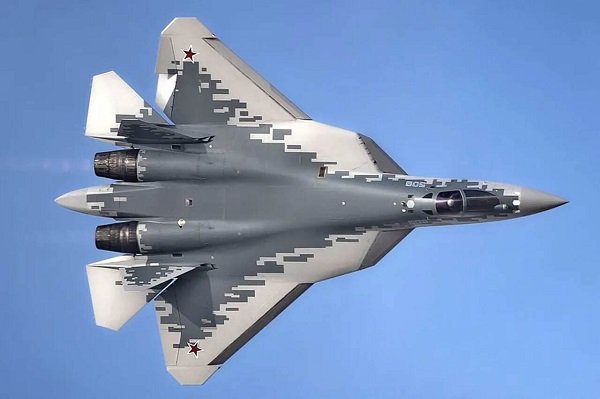
New Delhi. Talks are going on between India and Russia to jointly develop the 5th generation fighter aircraft Sukhoi Su-57E, which has now advanced to the technical level. The recent agreement between Hindustan Aeronautics Limited (HAL) and Russia’s United Aircraft Corporation (UAC) for the production of SJ-100 (Sukhoi Superjet 100) aircraft in India has created a stir in the defense circles. Now the biggest question arising is whether after civil aircraft, will the ‘dangerous’ Sukhoi Su-57 fighter aircraft become a part of the Indian Air Force (IAF) fleet?
SJ-100 agreement: a new turn
This agreement between India and Russia in the field of civil aviation is a big step towards ‘Make in India’. The SJ-100 is a regional jet, and its local production will strengthen the aerospace ecosystem in India. Experts believe that this partnership can prove to be a ‘test case’ for future military agreements.
What did Russian officials say?
A top official of the Russian aerospace company itself claimed that India and Russia are discussing technical aspects to explore the possibility of joint production of the fifth generation Sukhoi Su-57E fighter aircraft in India. However, there has been no response from the Indian side on the officer’s claim.
Vadim Badekha, Chief Executive Officer (CEO) of Russia’s United Aircraft Corporation (UAC), told Russian reporters on the sidelines of the Wings India Air Show at Begumpet Airport in Hyderabad – We are in the advanced stage of technical negotiations on this contract. Given our experience, such contracts are about to be signed that will determine the direction of our cooperation for many decades. Russia showcased its latest regional transport aircraft – the Ilyushin IL-114-300 and the Sukhoi SJ-100 – during the exhibition. Badekha claimed that both sides are also discussing the licensed production of Su-57 fighter aircraft in the facilities currently used for the production of Su-30 aircraft in India and maximum utilization of Indian industry and Indian systems for the same.
Su-57 ‘Felon’: Russia’s deadliest fighter
Su-57 is Russia’s first 5th generation stealth fighter aircraft. Some of its key features make it special. As-
Stealth Technology: It is capable of avoiding radar detection.
Supercruise: The ability to fly faster than the speed of sound without afterburner.
Weapons: Modern missiles are hidden in its internal weapon bay, which maintains its stealth.
History of India and Su-57 (FGFA Program)
You might remember that India was earlier a part of the FGFA (Fifth Generation Fighter Aircraft) program with Russia, which was based on the Su-57. But in 2018, India withdrew from this project. The main reasons for this were:
Lack of engine technology.
Dissatisfaction with stealth features.
Cost and transfer of technology (ToT) issues.
Are the tables turning now?
There are three main reasons why the Su-57 discussion started again after the SJ-100 deal-
New engine (AL-51F1) – Russia has now developed a new ‘Stage 2’ engine for the Su-57, which can address India’s old complaints.
Combat Experience – Russia has made limited use of the Su-57 in the Ukraine war, which has revealed real figures of its operational capability.
China’s challenge – In view of the increasing number of 5th generation aircraft like J-20 with China, the Indian Air Force soon needs a stealth fighter.
Challenges and ‘self-reliant India’
Even though Russia is offering India the Su-57, India faces some tough choices. Actually, India is developing its indigenous 5th generation aircraft AMCA. Buying Su-57 may affect the budget and priority of this indigenous project. Additionally, there is always the threat of US CAATSA sanctions on major defense deals with Russia. India is no longer interested in just ‘buying’ but in ‘making in India’ and acquiring ‘complete technology’.
Earlier, Alexander Mikheev, CEO of state arms exporter Rosoboronexport, had announced that the company was offering New Delhi the supply of the latest fifth-generation Su-57E fighter aircraft, as well as assistance in their production in India and the development of the indigenous AMCA stealth fighter aircraft, according to Russia’s state news agency RIA Novosti.
Overall, the SJ-100 agreement shows that industrial ties between India and Russia remain deep. If Russia offers full transfer of technology (ToT) for Su-57 and cooperation in indigenous AMCA, ‘Felon’ may be seen protecting India’s skies. However, right now the main focus of the Air Force is on the next batch of Rafale and indigenous aircraft.