


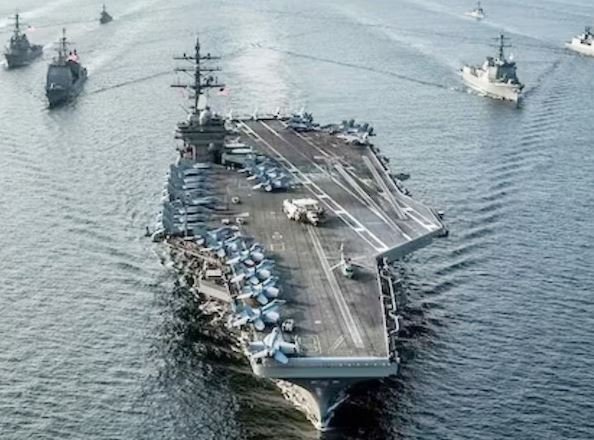
Washington. The sound of war has once again intensified in the Middle East as military tension between America and Iran has reached its highest level. The US Navy’s huge aircraft carrier USS Abraham Lincoln has been deployed in the strategic waters of West Asia along with three other deadly warships. This huge military gathering has created a stir in the entire area. According to unconfirmed reports, Iran’s Supreme Leader Ayatollah Ali Khamenei has been shifted to a secure bunker due to security reasons and the command of the administration is currently in the hands of his son. Although America’s Central Command has described this deployment as only a step to maintain regional security and stability, but in diplomatic circles it is being seen as a preparation for a decisive attack on Iran.
Military sources and international media reports claim that the US has identified senior Iranian officials and targets who are considered responsible for repressive policies and regional instability. According to intelligence inputs, Iran’s internal situation is currently going through its weakest phase since the 1979 revolution. Not only is the country facing a serious economic crisis, but the government’s grip on the public has also become much looser than before. US President Donald Trump has been informed by intelligence agencies that this could be the most opportune time to weaken Iran’s military and strategic capabilities. The Trump administration has warned Iran that if the situation worsens, it will not back down from military action.
Amidst this possible conflict, geopolitical equations are also changing rapidly. Iran’s neighbor and regional power, the United Arab Emirates (UAE), has taken a tough stance in this matter and made it clear that it respects its sovereignty and will not be a part of any war. The UAE Foreign Ministry has officially announced that it will not allow its land, airspace or maritime border to be used for any military attack against Iran. This announcement is being considered a major diplomatic blow for America, because conducting a large-scale military operation without the cooperation of the Gulf countries can be challenging. The UAE has made it clear that it will neither provide bases nor provide any logistical support for any hostile activity.
On the other hand, Iran has responded to these threats in a very harsh tone. Senior Tehran officials say their military is on high alert and any small or limited attack would be considered a declaration of full war. Iran has warned that if its nuclear bases or military installations are targeted, its response will be so severe that the entire region will be hit. It is noteworthy that last year also during similar tension, America had targeted some specific targets through its B-2 bombers. Currently, the presence of the American naval fleet, which is being called Armada, in the Gulf region has indicated that the coming few days are going to be extremely sensitive from the point of view of global peace and oil supply.