

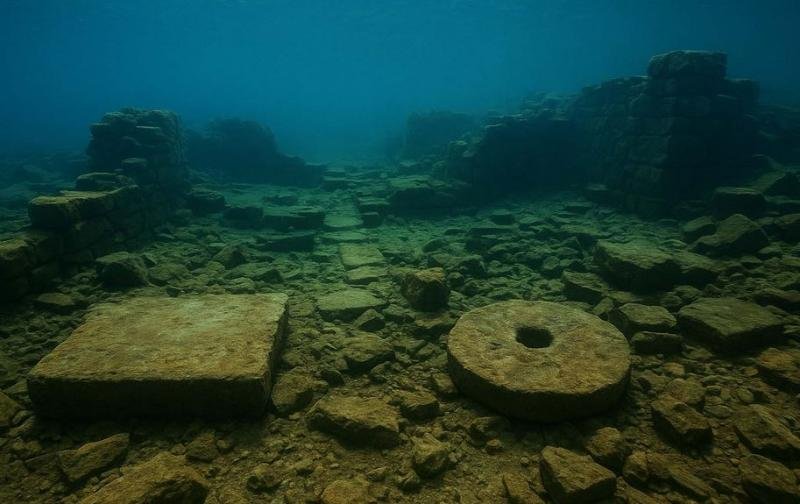


Bishkek. Plato’s story of Atlantis is in discussion again. The reason for this discussion is a new discovery. Archaeologists of the Russian Academy of Sciences have uncovered traces of a sunken city destroyed in a devastating 15th century earthquake beneath Kyrgyzstan’s Issyk Kul Lake. This is the eighth deepest lake in the world, from which this amazing discovery has been made.
According to reports, the city, located in the flooded Toru-Aygir complex near the north-western point of the lake, was discovered by explorers during excavations. Experts have surveyed four underwater areas at shallow depths of 3 to 13 feet around the lake’s shoreline. Here they found this ancient city.
Experts have found a huge pile of everyday items from the excavation site. It shows a once prosperous metropolis or a large business group. During the discovery many structures made of baked bricks have been found. It also has a millstone, which was used to crush and grind grains. In addition there are sunken stone structures and wooden beams.
Archaeologists estimate that they have also found a public building in one area, which could be a mosque, bathhouse or school building. Remains of cemeteries have been found in three other areas. This huge cemetery is connected to an ancient city. Structures made of round and rectangular shaped mud bricks have also been found here. Excavations have also uncovered burial sites, which provide evidence of traditional Islamic rituals. In this the skeletons are facing north. They face the Qibla, the direction Muslims face during prayers. The Russian Geographical Society said it confirms that an ancient city once existed here.
The extinct Toru-Aygir settlement existed on a large part of the Silk Road that gave rise to historical culture. Here merchants traded silk, spices and metals between China and the Mediterranean Sea from the 2nd century BC to the mid-15th century. The complex once flourished but was destroyed by a terrible earthquake in the early 15th century.