

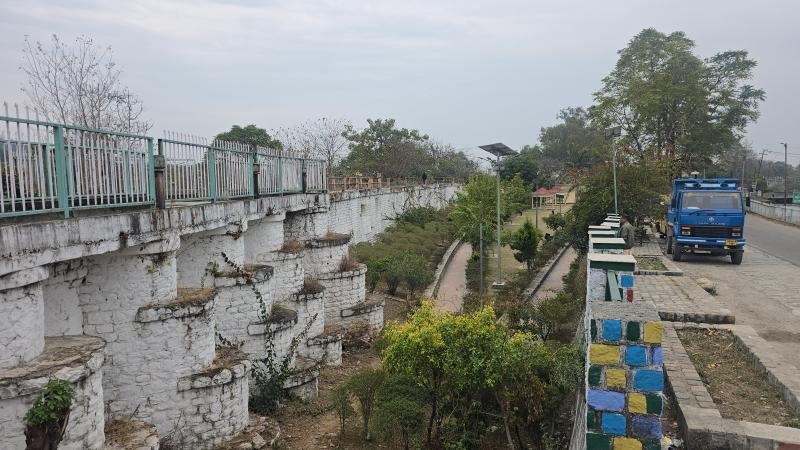

Ramnagar (Nainital): Kosi embankment located in Ramnagar, Uttarakhand has completed 100 years of its construction. This huge embankment, built during the British rule in the year 1926, is still providing protection to Ramnagar and surrounding areas from the floods of Kosi River. This journey of a century is not just a story of bricks and stones, but is a symbol of the visionary thinking which gave a new direction to the settlement, farming, irrigation and social life of Ramnagar.
It is believed that Ramnagar was established Sir Henry Ramsey, the then Commissioner of Kumaon Was done by. This area was very important strategically due to adequate availability of water, dense forests and fuel. Ramnagar is considered the gateway to Kumaon and Garhwal. Not only this, it is also the main entry point to the world famous Corbett National Park, which is known to have one of the highest density populations of tigers in the world.
Plan born out of flood tragedy: In the early years of the 20th century, Kosi River was the biggest challenge for the Ramnagar region. According to experts, there was heavy rain here in the years 1910 and 1913, due to which the Kosi river came into spate. Thousands of acres of agricultural land was washed away. Villages and settlements were destroyed and there was massive destruction. These devastating floods of that time forced the British government to think of a permanent solution.
As a result of this, in the year 1926, a strong embankment was constructed on the banks of Kosi river, which is known by the local people as ‘Latha’ or ‘Banda’. This embankment was made of stone, lime and lead, the foundation of which was kept so strong that it is still standing firmly in place even after a century.
What is Kosi ‘Latha’: The Kosi ‘Latha’, a massive protective wall, was intended to control the floods of the Kosi River and protect the city of Ramnagar, farms and settlements. In fact, during the rainy season, the water level of Kosi river increases rapidly and with it comes heavy debris and fast flow. The log controls the rising water and prevents it from moving towards the city.
Local expert Vinod Papne It is said that whenever there was a flood, people used to climb on this log and come to see the monstrous form of Kosi river. Thousands of people from Ramnagar city and surrounding areas used to gather here. Hearing the roar of Kosi water, people used to understand that the river is in spate. At that time, this log was not only a means of security, but also became a kind of observation center for the people.
Kosi ‘Latha’ is also known as ‘China Wall’ due to its extraordinary strength. This embankment, approximately one and a quarter kilometer long, is an excellent example of the engineering capability of that time. Its walls were made of big stones, which were joined with lime and lead. This is the reason why even after 100 years this structure is still standing. Along with Kosi ‘Latha’, three important canals were also constructed.
– Vinod Papne, local expert –
Vinod Papne says that Ramnagar’s Belgarh Canal, Ramnagar Canal and Chilkia Canal are still in operation and remain important means of irrigation in rural areas. It is clear that this project was not limited to just flood control, but was also a visionary plan to strengthen agriculture and rural economy.
Kosi ‘Latha’ is not just an embankment but is the historical heritage of Ramnagar. It should be formally declared heritage, so that future generations can know its history and importance. Ramnagar has been a historical city and many heritage buildings are present here. The Kosi Latha made by the British is also a part of the same heritage.
– Sanjay Chhimwal, local expert –
Sanjay tells that, at that time, the settlement of Ramnagar developed around this embankment. Ramnagar was sometimes called ‘Ramjay City’ after the name of Sir Henry Ramjay, who was the Commissioner of Kumaon, which later became famous as Ramnagar.
This wall is still very important from the point of view of flood protection. If any man-made structure completes 100 years, it comes under the category of heritage. Kosi ‘Latha’ is an example for Ramnagar. But in the last few years, due to increasing land erosion, some parts of it have weakened.
– Sanjay Chhimwal, local expert –
Even today the lifeline of Ramnagar: Expert Narendra Sharma says that Ramnagar city was founded by Henry Ramsey and it has been the gateway to Kumaon-Garhwal. Kosi ‘Latha’ was built in the year 1926 and today it has completed 100 years. At one time, irrigation through this log was widely used in rural areas.
Due to its quality and strong construction, this log is still standing today and even in the current circumstances, it is working like a lifeline in saving Ramnagar from floods. This clearly shows how big and far-sighted the thinking must have been behind its construction.
– Narendra Sharma, local expert –
On the question raised regarding the security of this historical security wall. Rajeev Khanulia, Assistant Engineer, Irrigation Department It is said that Kosi Latha is continuously maintained by the Irrigation Department. Wherever there is damage, repair and maintenance work is done. He has demanded that this heritage should be declared as such structures have become very rare and are not found in today’s time. The department is trying to keep this historical embankment safe, so that it continues to protect Ramnagar from floods in future also.