

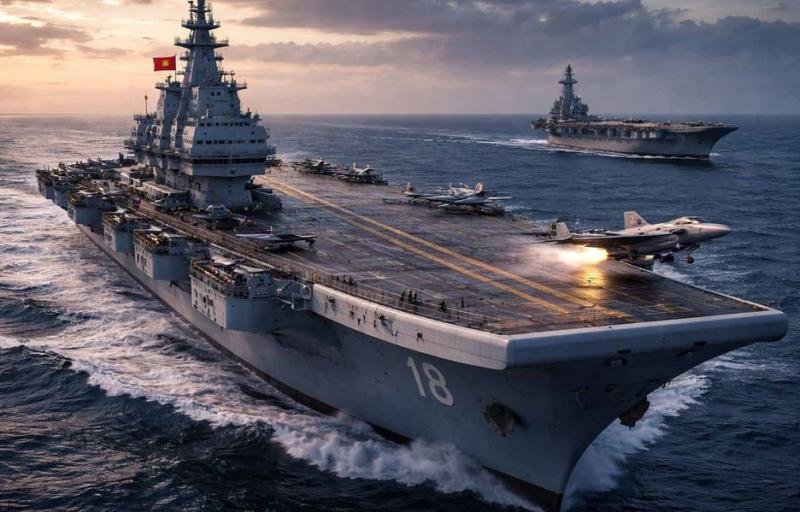

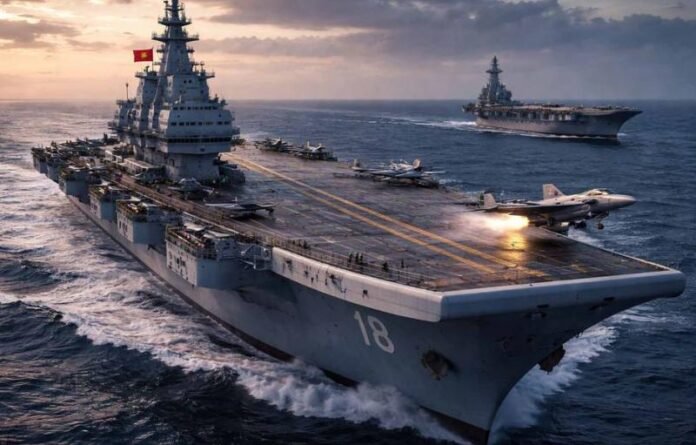
Beijing. China’s new aircraft carrier Fujian is scheduled to officially enter service in November 2025 and is being considered a symbol of Beijing’s rapidly growing maritime power. Weighing about 80 thousand tons, this ship is China’s first completely indigenously designed aircraft carrier, which is equipped with modern electromagnetic catapult systems. It was also described as the world’s largest conventionally fueled warship, but recent technical assessments have revealed flaws in its design. These shortcomings have now inspired China to move towards the development of a much larger and nuclear energy powered aircraft carrier.
According to media reports, according to military experts and independent analysts, Fujian’s biggest problem is related to its flight deck layout. Unlike American supercarriers, Fujian’s ‘island superstructure’ is located amidships of the flight deck, whereas American ships have it aft. This design limits the space available for parking and movement of aircraft, hindering high-speed flight operations. As a result, problems are being faced during take-off and movement of fighter jets on the deck.
The condition of the catapult system has further compounded these problems. The electromagnetic launch system in Fujian may be state-of-the-art, but one of the catapults interferes with the landing zone, making it impossible to use during landing. Another catapult is located very close to the aircraft lift, which creates a ‘choke point’. It is believed that these compromises were made due to the change in construction from steam-powered catapults to electromagnetic systems, which had a direct impact on the entire flight deck operation. The width and depth of its angled flight deck is also said to be less than American designs, making landing in bad weather and rough sea conditions more challenging.
According to reports, the root of these problems is the propulsion system running on conventional fuel. The large exhaust funnels and engine room limit the position of the island and elevators, disrupting the flow of the flight deck. In contrast, nuclear energy powered aircraft carriers do not require such heavy propulsion systems. This gives designers the freedom to move the island back, better position the catapult, and make the deck more spacious. Now China is working on a plan to develop a nuclear aircraft carrier larger than America’s Gerald R Ford class. It is believed that based on the experience gained from the shortcomings of Fujian, China will try to make its next generation aircraft carrier more capable, faster and strategically effective.