


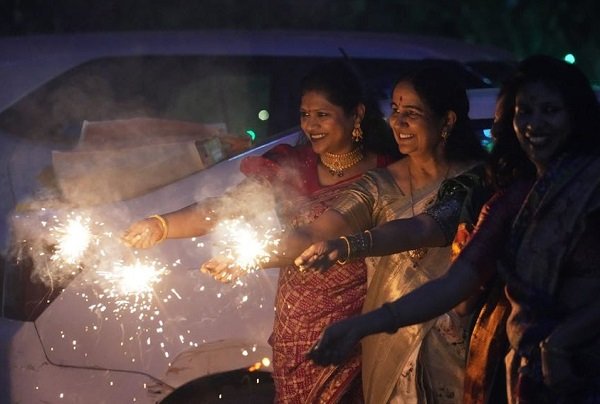
New Delhi. The air quality of Delhi remained in poor condition on Diwali night. But, it is a matter of relief that this time the air of the capital did not become as poisonous as compared to the last Diwali night i.e. 31 October 2024. At around 5 am on Tuesday morning, the Air Quality Index (AQI Level) in Delhi was recorded between 300 and 350, which is almost half of the last Diwali night. 338 were recorded in Dwarka sector, Burari 387, IGI Airport 299, Padparganj 343, Mundka 350, Anand Vihar 341, Chandni Chowk 341, Mandir Marg 328 and ITO 347. The AQI level was 315 points in Lodhi Road and 351 points in Pusa.
AQI level at 6 o’clock
418 were recorded in Bawana, 408 in Wazirpur, 404 in Jahangirpuri, 393 in Burari Crossing, 393 in Shadipur, 389 in Dwarka and 352 in Anand Vihar. According to CPCB, the overall AQI of Delhi was 346. Major Dhyan Chand Stadium recorded 358, Aya Nagar 349 and Chandni Chowk 347 AQI.
Last year, on the night of 31 October, the AQI level in Delhi-NCR had crossed 900 points. It was 911 point in Vaishali, NCR. Whereas in Karkardooma, Delhi it was recorded 806. Last year, the AQI level remained around 600 in almost all the areas of the capital.
However, this time the people of Delhi can heave a sigh of relief. Delhi’s air quality remained poor on Monday, the day of Diwali, with pollution levels at 34 out of 38 monitoring stations recorded in the ‘red zone’, indicating ‘very poor’ to ‘severe’ air quality. According to official data, Delhi’s 24-hour average air quality index (AQI) at 4 pm was 345, which falls in the ‘very poor’ category, while it was recorded at 326 on Sunday.
AAQI had crossed 400 on Monday
According to the Central Pollution Control Board (CPCB)’s ‘Sameer’ app, four monitoring stations already reported air quality in the ‘severe’ category, with AQI levels above 400. In this, AQI was recorded at 417 in Dwarka, 404 in Ashok Vihar, 423 in Wazirpur and 404 in Anand Vihar.
Around 30 monitoring stations in Delhi reported the AQI to be in the ‘very poor’ category with its level above 300. According to the data, air quality was recorded in the ‘very poor’ category at 31 out of 38 monitoring stations in the afternoon, while it was in the ‘severe’ category at three stations. The air quality in Delhi is expected to reach ‘severe’ category on Tuesday and Wednesday. An AQI between zero and 50 is considered ‘good’, 51 to 100 ‘satisfactory’, 101 to 200 ‘moderate’, 201 to 300 ‘poor’, 301 to 400 ‘very poor’ and 401 to 500 ‘severe’.
Decision Support System (DSS) data showed that transport emissions contributed 15.6 per cent to air pollution in Delhi on Monday, while other factors, including industries, contributed 23.3 per cent. Earlier, the Commission for Air Quality Management (CAQM) imposed restrictions in the second phase of the Phased Response Action Plan (GRAP) in Delhi-NCR.
On October 15, the Supreme Court had given permission for the sale and use of green firecrackers in Delhi-NCR with certain conditions. Under this, permission was given to burst green crackers a day before Diwali and between 6 am to 7 pm on the day of the festival and again from 8 pm to 10 pm.