

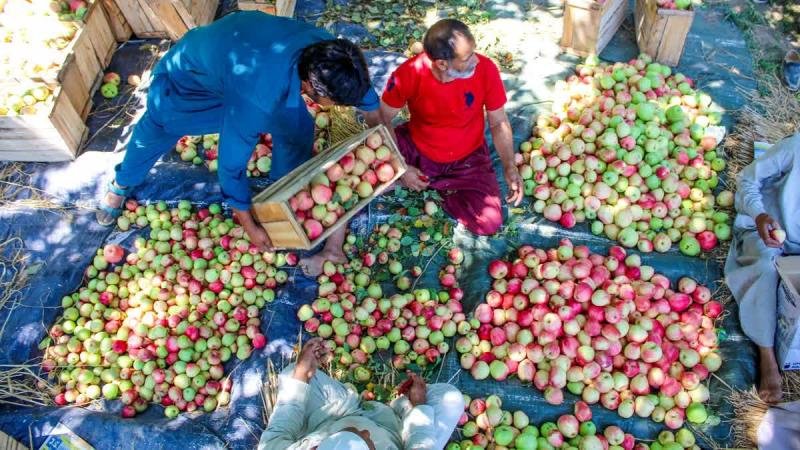

Srinagar: There is growing concern among farmers in the Himalayan states as they fear that they will be financially ruined by the fruits imported from the US as part of the India-US interim trade framework. Harish Chauhan, convenor of Samyukt Kisan Manch, a group of more than two dozen farmer organizations, said this would be the third blow to the apple economy in the country.
The Himachal Pradesh farmer leader was referring to India’s trade agreement with New Zealand after the European Union, which is being described as the ‘mother of all deals’, which could become a problem for farmers after the import duty is reduced. Under free trade agreements, India has reduced import duty on apples and other fruits from New Zealand and the European Union from 50% to 20%.
Chauhan told ETV Bharat, “Apple is at the top among fruits and the government clearly says that the import duty will be reduced to 25 per cent. The minimum import price (MIP) is Rs 80 per kg. The base rate will be MIP. Therefore, it will destroy the economy of apple because we cannot compete with the farmers of America or New Zealand. This will make the apples imported in the three trade deals cheaper by Rs 15-20 per kg in the Indian markets.”
Chauhan said, “The current duty levied on a box (20 kg) of apples coming from the US, its price in the Indian markets is between Rs 2500-2700. But after removing the landing and import costs, it will be sold at half the price. This will hurt our premium apples as their rates will become very low. In the domestic market, our apples will become cheaper to make American products easier to sell.”
India produces 2.5 MT (metric ton) of apples, which is 2 percent of the world’s total production. Of this, 75 percent of the total produce is produced in Kashmir, earning more than Rs 12,0000 crore annually. Apple is cultivated on more than 2 lakh hectares of land, in which Jammu and Kashmir, Himachal Pradesh and Uttarakhand are the main apple producing states. But apple farmers and trade unions estimate that India’s recent trade agreements will lead to a 50 percent decline in prices.
In Jammu and Kashmir, which is the main producer of apples, this sector directly or indirectly provides livelihood to more than seven lakh families. Mohammad Abbas is worried after knowing the basic details of the India-US trade deal, which is affecting small farmers like him. Abbas, a 35-year-old third-generation apple grower from Shopian, has 20 kanals of orchards and is already in debt after his crop was damaged in floods last year.
This will push farmers like me further into financial crisis. We are already struggling with the effects of climate change such as flash floods, less snowfall, rain, less production etc. These conditions have given rise to new diseases and require pesticides which are expensive. These sprays have affected our health and now we will have to suffer financially too.”
On Friday (February 6), India and the US announced a Framework for Interim Agreement on Mutually Beneficial Trade. The joint statement said the framework reaffirms the countries’ commitment to the larger Bilateral Trade Agreement (BTA) negotiations initiated by Prime Minister Narendra Modi and US President Donald Trump on February 13, 2025, which will include commitments for additional market access and support for more robust supply chains.
According to the statement, India will eliminate or reduce tariffs on all US industrial goods and a variety of food and agricultural products, including dried distillers grains (DDGs), red sorghum for animal feed, tree nuts, fresh and processed fruits, soybean oil, wine and spirits and other products.
On Saturday, Union Commerce and Industry Minister Piyush Goyal said the India-US Interim Trade Framework expands export opportunities without giving any exemption on dairy or other sensitive domestic products, thereby opening up access to the nearly US$30 trillion economy under the most preferential duty terms for Indian exporters. He said that the interests of Indian farmers have been fully taken care of.
But from Himachal Pradesh to Kashmir, this assurance has not allayed the fears of the farmers, because they fear that when imported apples start arriving in the Indian markets, their livelihood will be affected by up to 50 percent.
A farmer said, “American apples may not be as nutritious as our varieties. But they are polished and red in color. This makes them more appealing to customers.”
Farmers of Kashmir wrote a letter to Prime Minister Narendra Modi demanding 100 percent duty on imported apples for the safety of the farmers. Bashir Ahmed Bashir, President of Kashmir Valley Fruit Growers cum Dealers Union, wrote in the letter, “Every year new challenges arise for the apple industry of the valley, Himachal and Uttarakhand. Sometimes apples are imported from Iran and sometimes from America and other countries also.”