


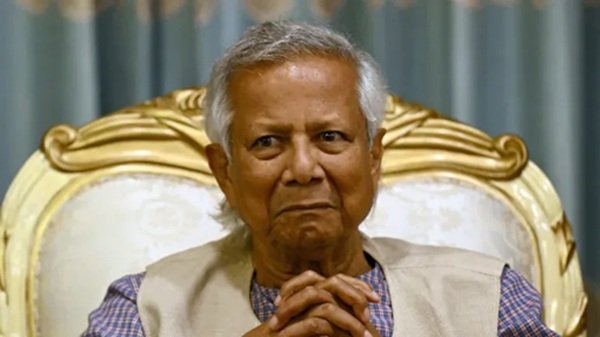
New Delhi . The recent incidents in Bangladesh regarding India have created a lot of discussion. Especially an old prediction of interim leader and Nobel Prize winning economist Muhammad Yunus is going viral. Last year i.e. in 2025, Yunus seemed very happy with Trump’s huge tariffs on India. Not only this, he even claimed that Indian industries (especially the textile sector) will set up factories in Bangladesh because the production cost there is very low.
In an interview with American journalist Mehdi Hasan, Yunus had claimed that – ‘Due to the heavy tariffs imposed on India by US President Donald Trump, Indian industries will leave India and move to Bangladesh. America’s tariffs on India are high, while Bangladesh has got low tariffs due to which Indian companies will set up their factories in Bangladesh. But today’s reality is that Bangladesh’s own textile mills are on the verge of closure.
Domestic textile industry on the verge of closure
At the end of January 2026, Bangladesh’s textile industry is standing at the brink of a major crisis. On one hand, the head of the interim government, Mohammad Yunus, was taunting India on the pretext of American tariffs, while on the other hand, the country’s own domestic textile industry is on the verge of closure. The ground reality of Bangladesh is quite worrying. Bangladesh Textile Mills Association (BTMA) has announced that all textile mills in the country will be closed indefinitely from 1 February 2026.
BTMA President Shaukat Aziz Russell said in the press conference that the mill owners do not have the ability to repay the bank loans. Their capital has declined by more than 50%, and many mills have already closed. Bangladeshi mills allege that cheap yarn coming from India has destroyed the domestic market. Local stock worth about Tk 12,000 crore is lying unsold. Due to severe shortage of gas and rising prices, production capacity has fallen by 50%. BTMA demands that the government should withdraw the duty-free facility on import of 10-30 count yarn and ensure uninterrupted supply of gas.
India-EU deal: alarm bell for Bangladesh
The proposed Free Trade Agreement (FTA) between India and the European Union (EU) is being called the Mother of All Deals. This is going to prove to be the biggest challenge for Bangladesh’s garment exports. Currently, Bangladesh, being an LDC (least developed country), gets duty-free access to the EU, while India has to pay 12% tax.
After this deal, India will also get 0% tariff. India has its own raw materials (cotton and yarn). Once the duty is removed, Indian clothes will become cheaper and of better quality than Bangladeshi clothes. Bangladesh will move out of the LDC category by 2026-27, thereby losing its own duty-free quota. In such a situation, it will be almost impossible to compete with India. Every third person in the EU wears Bangladeshi denim. After the deal, India can capture a large part of this market.
While on one hand Mohammad Yunus was expressing hope of Indian companies coming to Bangladesh, the reality is that Bangladesh’s own ‘backward linkage’ (mills producing yarn and cloth) is closing down.