

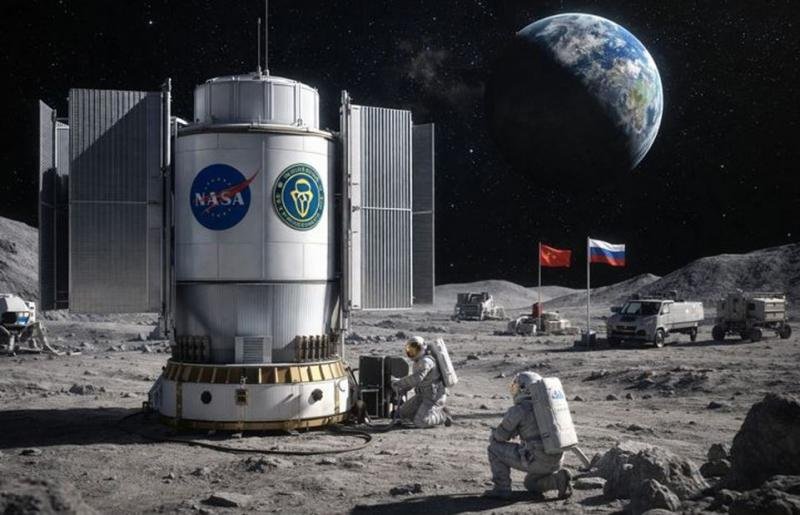

Washington. The US space agency NASA and the US Department of Energy have formally advanced the process of establishing a nuclear fission-based power system on the Moon. The aim of this plan is to deploy a reactor on the lunar surface by 2030 that can provide continuous power to permanent human and robotic missions there. This initiative has come at a time when China and Russia are also moving rapidly towards jointly developing nuclear reactors on the Moon, thereby intensifying the global competition in space. This project is considered the cornerstone of NASA’s ambitious Artemis mission and future Mars missions. This collaboration is strengthened by a formal agreement between NASA and the Department of Energy that aims to maintain America’s leadership in space science and establish a reliable energy infrastructure for a long-term, sustainable presence on the Moon. Officials believe that without a stable and powerful energy source, it will not be possible to build a permanent base on the Moon and conduct continuous missions there.
Under this plan, a fission surface power system is being developed, which will be capable of providing continuous power even in the harsh conditions of the Moon. The Moon faces challenges such as prolonged darkness, extreme cold, and wide fluctuations in temperature, where solar energy is not always a reliable option. In such a situation, the nuclear fission based system can work for years without refueling and can provide electricity 24 hours a day. This is why it is being considered very important for future lunar missions. NASA Administrator Jared Isaacman has clearly said that America no longer wants to be limited to just returning to the Moon, but is making concrete preparations to stay there and further reach Mars. According to him, the use of nuclear energy has become mandatory under the national space policy, because only this technology can make deep space missions practical and sustainable.
This collaboration between NASA and the Department of Energy will usher in a new era of space exploration. US Energy Minister Chris Wright has also linked this agreement to America’s scientific heritage. He said that whenever American science and innovation have worked together, the country has achieved goals that were considered impossible. History is witness to it from the Manhattan Project to the Apollo Mission. According to him, this initiative carries forward the same tradition under the existing ‘America First Space Policy’.