


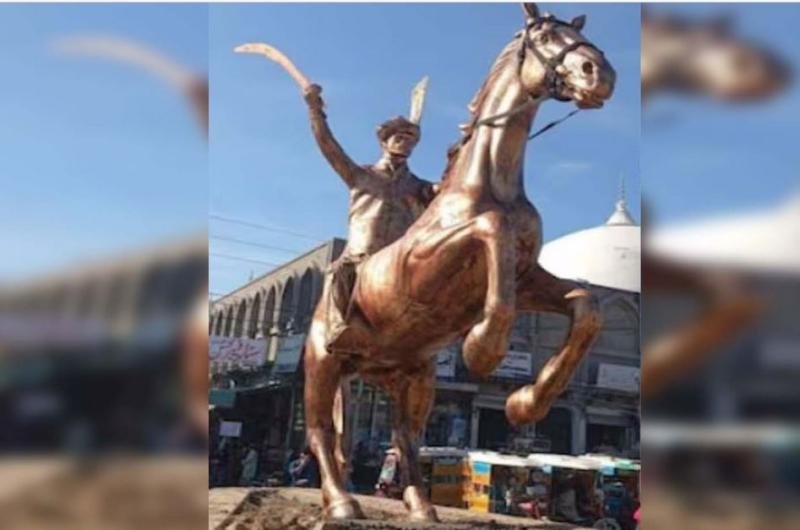
Lahore,. The news of removal of Shershah Suri’s statue in Jhelum in Punjab province of Pakistan has sparked debate. A few days ago, the local administration removed the statue installed at the intersection and replaced it with the statue of Sultan Sarang Khan Gakhar. Similarly, in some areas of Sindh, there have been reports of removal of statues and symbols related to old rulers. The question is being raised that why distance is being maintained from those historical personalities whom Pakistan has been proud of for decades? The incident of removal of Shershah Suri’s statue has raised the question whether Pakistan is now looking at its historical symbols with a new eye? Why are their statues being removed now and replaced with local heroes?
According to media reports, Pakistan, which was formed after separating from India in 1947, had laid its ideological foundation on Muslim identity. The country’s founder Muhammad Ali Jinnah had envisioned a separate nation. After this, medieval Islamic rulers were given prominence in the history writing of Pakistan. Rulers like Shershah Suri, Mahmud Ghazni and Muhammad Ghori were presented in textbooks there as symbols of Muslim power and victory. Sher Shah Suri was described as the builder of the Grand Trunk Road and an efficient administrator. Mahmud Ghaznavi and Muhammad Ghori were described as the founders of Muslim rule in the Indian subcontinent and considered heroes of the Pakistani Muslim community.
Pakistan also named its military equipment after these rulers. For example, Pakistan’s short range ballistic missile was named Ghaznavi and its medium range missile was named Ghauri. This shows that these historical figures were associated with national pride. In such a situation, it is not easy to consider the removal of Sher Shah Suri’s statue in Jhelum as merely a local administrative decision. Let us tell you that Shershah Suri was born in Sasaram, Bihar at the end of the 15th century. He belonged to the Suri clan of Afghan origin. He captured the throne of Delhi in the 16th century and ousted the Mughal emperor Humayun from power for some time. Sher Shah Suri (1486–1545) was the founder of the Suri Empire in North India. He ruled Delhi for only five years from 1540 to 1545. His reign was short, but he is known for administrative reforms. He made changes in roads, postal system and revenue system. This is why he is also remembered as a capable ruler in Indian history.
Historians say that both Mahmud Ghaznavi and Mohammad Ghauri had their origins in Afghanistan and Central Asia. In recent years, there has been tension in the relations between Pakistan and Afghanistan. Border skirmishes and diplomatic differences have affected relations between the two countries. Historical symbols are now being reinterpreted in Pakistan. Installing the statue of Sultan Sarang Khan Gakhar in Jhelum is also considered to be a part of this process, where efforts are being made to bring forward local heroes.
Debate broke out on removal of Shershah Suri’s statue in Pakistan, Sarang Khan’s statue installed
Before relying on or taking any action based on the news, articles, or sponsored content published on this website, we strongly recommend reviewing our Legal Disclaimer . By accessing and using this website, you acknowledge and agree to the terms outlined therein.