
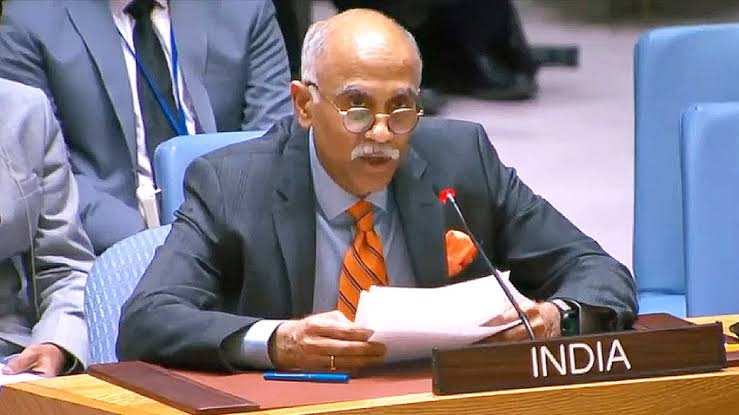

New Delhi. The ever-deepening military and political tensions in the Middle East have increased the concerns of the Indian government. About one crore Indian citizens live in this region and contribute significantly to the economy there, ensuring their security has now become the top priority of the Central Government. During an open debate at the United Nations Security Council (UNSC), India’s Permanent Representative Parvathneni Harish made the country’s stand clear and called for an immediate stop to the attacks and the start of talks. The tragic death of an Indian in Riyadh and the series of attacks on Indian flagged commercial vessels have further aggravated this crisis.
Condolences expressed over the death of an Indian in Riyadh
According to the Ministry of External Affairs and diplomatic sources, India’s Permanent Representative to the United Nations Parvathaneni Harish said that the well-being and security of about one crore Indians living in the Gulf Cooperation Council (GCC) member countries is the fundamental basis of India’s bilateral relations. India strongly condemned the recent attacks targeting civilian targets and expressed deep sorrow over the death of Indian national Mohammed Yusuf Ali in Riyadh. In this hour of crisis, India expressed full solidarity with the Government and people of Saudi Arabia and supported their sovereignty.
Attacks on merchant ships and sailors
Attacks on Indian-flagged ships and manned Indian sailors on international sea routes are a cause of grave concern for India. Indian-flagged ‘MV DP World Kaveri’ was attacked this week, while ‘MT Petro Dolphin’ and ‘MT Valthera’ were also targeted last week. India bluntly said that attacks on merchant ships and innocent seafarers are not only a crime in law but are also completely wrong from a moral point of view. The Government of India expressed official gratitude to the authorities of Oman and the United Arab Emirates (UAE) for assisting Indian seafarers during the crisis.
India’s emphasis on diplomacy and dialogue
India has appealed to all concerned parties to immediately reduce military tensions and find a permanent solution to the disputes through diplomatic dialogue. India stressed that the security and unhindered movement of trade through sea routes must be ensured under international law. Describing the safety of sailors as its primary responsibility, India warned that if such attacks continued, the situation in the already sensitive region could worsen further.
Emergency Support Network Proposal
It is noteworthy that during the BRICS summit held last month, Prime Minister Narendra Modi had made a visionary proposal to establish a special ‘Emergency Assistance Network’ in the interest of seafarers. The objective of this system is to connect the maritime authorities and embassies of the respective countries so that in case of any emergency, issuing quick alerts, providing immediate medical care, contacting the families and facilitating safe evacuation if necessary.
Threat of crisis on global supply chain
This entire region of the Middle East is a major center for India’s energy security, crude oil supply and international trade. Due to increasing threats on strategic sea routes like the Red Sea and the Suez Canal, there is a fear that the global supply chain will be severely affected. Economic experts believe that if the tension in this region increases further, it will not only have a direct and adverse impact on the lives of Indian expatriates, but the entire global economy may also face a major crisis.