
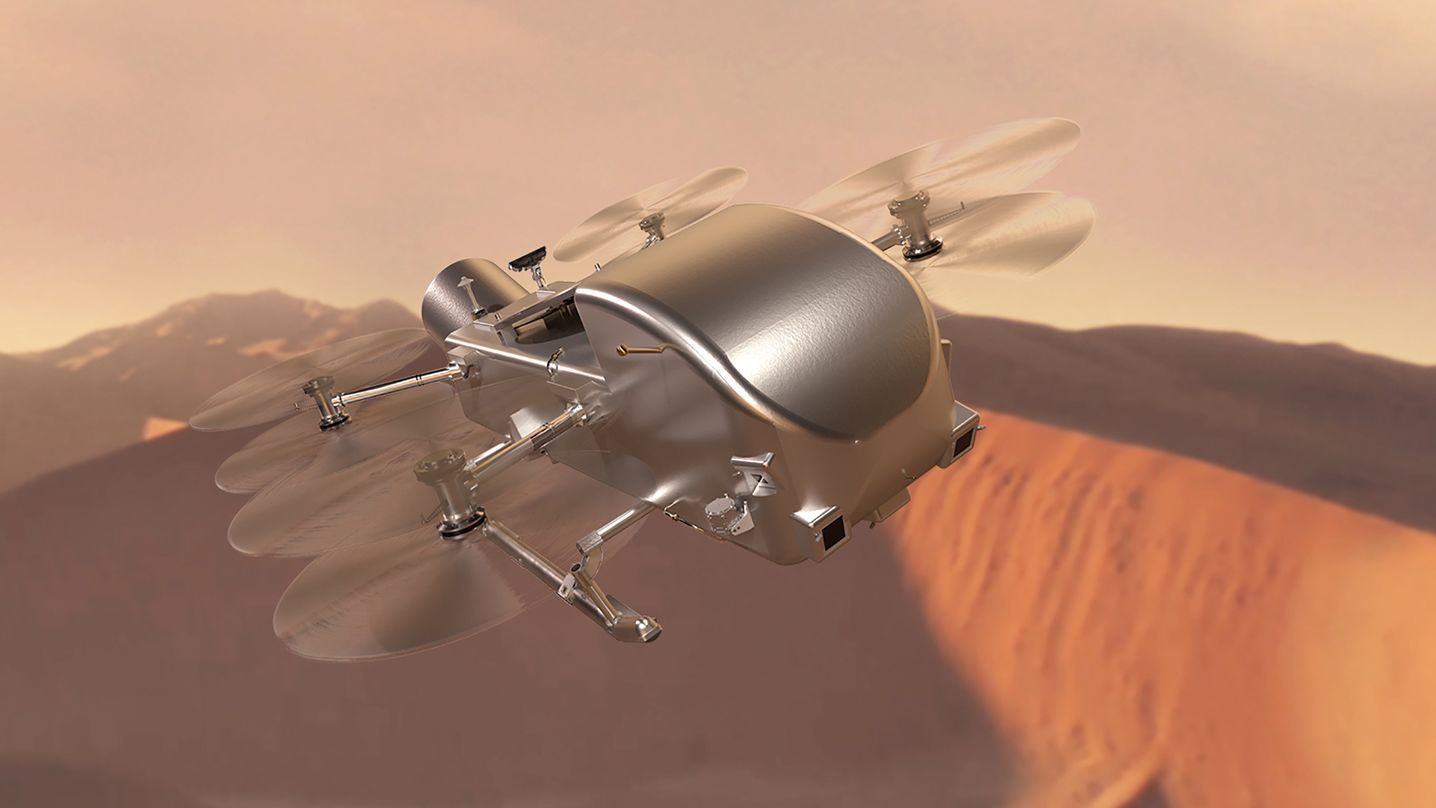
NASA has moved ahead with the construction phase of its ambitious Dragonfly mission, a first‑of‑its‑kind nuclear‑powered robotic drone designed to explore the surface of Saturn’s largest moon, Titan. The aerospace agency announced that the drone’s rotorcraft elements are now entering a critical integration and testing stage, marking a significant milestone in the mission’s timeline as it moves toward a scheduled 2028 launch.
Dragonfly’s advanced design leverages a compact nuclear power source, enabling the craft to fly autonomously across Titan’s icy terrain, gather scientific data, and search for signs of prebiotic chemistry. Scientists and engineers alike are hailing the project as one of NASA’s most innovative planetary exploration efforts in decades.
Why Titan and Why Now?
Titan has long been a magnet for scientific curiosity. Larger than the planet Mercury and boasting a thick, nitrogen‑rich atmosphere, Titan is one of the only worlds in the Solar System with stable liquids on its surface — in the form of hydrocarbon lakes and seas.
Researchers believe that studying Titan’s chemical makeup may offer insights into how life emerged on Earth. Its organic‑rich environment and potential subsurface ocean make it an ideal laboratory for studying chemical processes that could resemble pre‑life chemistry.
In recent years, data from NASA’s Cassini spacecraft and Earth‑based telescopes have deepened interest in Titan’s potential as a key to understanding astrobiology.
Dragonfly: The Mission Concept
Dragonfly is an innovative rotorcraft designed to fly like a drone across the low‑gravity atmosphere of Titan. Unlike traditional landers that remain fixed at a single site, Dragonfly will make multiple flights to diverse locations across Titan’s surface, vastly expanding the scientific scope of the mission.
At the heart of Dragonfly is a radioisotope thermoelectric generator (RTG) — the same type of power source used in the Curiosity and Perseverance Mars rovers. This nuclear system provides continuous electrical power and heat, enabling Dragonfly to operate through Titan’s frigid temperatures and long nights.
NASA selected the Dragonfly mission in 2019 under its New Frontiers program. The mission is managed by the Johns Hopkins Applied Physics Laboratory (APL), with scientific leadership from the Woods Hole Oceanographic Institution.
What Scientists Hope to Learn
Dragonfly’s suite of scientific instruments is designed to study the chemical composition of Titan’s surface and atmosphere. Key mission goals include:
-
Detecting complex organic molecules that may play a role in prebiotic chemistry
-
Analyzing surface geology to better understand Titan’s formation and evolution
-
Investigating seasonal and weather‑driven changes in Titan’s atmosphere
-
Searching for signs of chemical conditions favorable to life
Unlike Mars rovers, Dragonfly’s mobility allows it to examine multiple geologic environments — from dune fields to impact craters — offering a richer dataset than single‑location probes.
Progress and Engineering Challenges
In recent months, NASA has confirmed that Dragonfly’s rotorcraft and nuclear power systems are undergoing rigorous testing. Engineers are focusing on ensuring the craft’s structural integrity and autonomous flight systems can handle Titan’s dense air and extremely low temperatures.
One major challenge has been optimizing the drone’s ability to navigate while maintaining communication with Earth — a journey that involves a travel time of about 80 minutes round trip for signals.
Given Titan’s distance, Dragonfly must rely heavily on autonomous systems and pre‑programmed flight sequences, making reliability and redundancy key design priorities.
What Sets Dragonfly Apart
Dragonfly’s nuclear power system offers unique advantages over solar‑powered spacecraft. Titan receives far less sunlight than Earth or Mars, making solar panels inefficient. The RTG not only supplies power but also keeps scientific instruments warm in temperatures that can dip below −180°C (−292°F).

Additionally, the rotorcraft’s ability to fly — rather than roll or crawl — enables it to reach multiple scientifically interesting sites that would be inaccessible to traditional rovers.
Looking Ahead
With construction underway and flight systems being assembled, NASA remains on track for Dragonfly’s 2028 launch window. After traveling across the Solar System, the craft is expected to arrive at Titan around 2034, where it will begin a multi‑year exploration campaign.

Scientists, engineers, and space enthusiasts worldwide are eagerly awaiting the mission’s findings, which promise to deepen humanity’s understanding of one of the most enigmatic moons in our Solar System.
Dragonfly’s progress underscores the power of long‑term scientific planning and international collaboration in space exploration — and, if successful, could redefine what robotic missions are capable of achieving beyond Earth.