
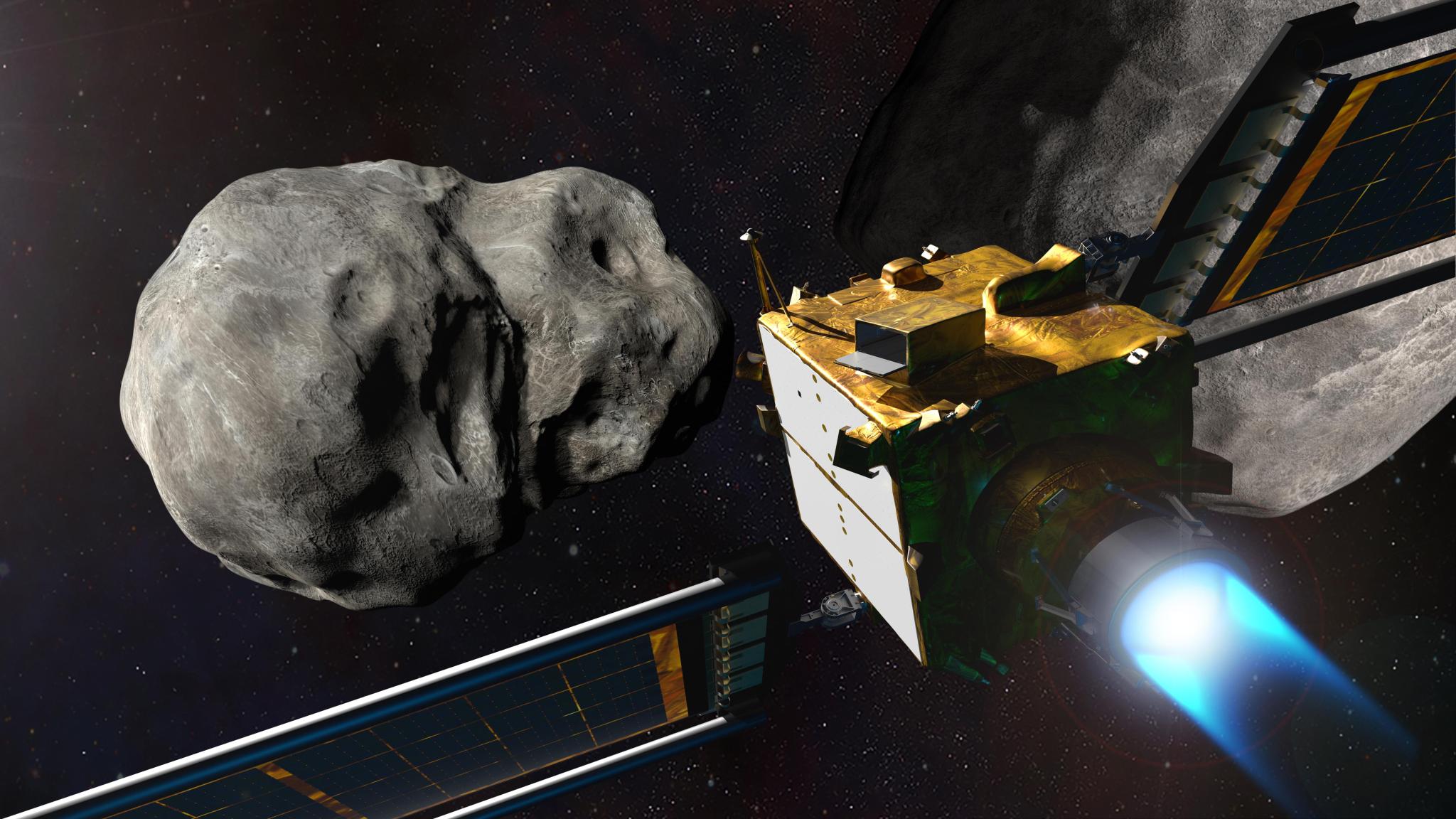
NASA’s groundbreaking Double Asteroid Redirection Test (DART) has become one of the most successful planetary defense experiments in history, with scientists confirming that the spacecraft’s impact on an asteroid altered the object’s orbit around the Sun — a key proof of concept for humanity’s ability to protect Earth from potential hazardous asteroids.
The mission, which culminated with DART’s intentional collision with the small moonlet Dimorphos in September 2022, was designed to see whether a spacecraft could change the trajectory of an asteroid through kinetic impact alone. Recent analyses show that the impact did, indeed, measurably alter the orbit of Dimorphos around its larger companion asteroid, Didymos — a milestone achievement for planetary defense.

A First for Planetary Protection
The DART spacecraft — a suitcase‑sized robotic probe — slammed into Dimorphos at a speed of about 15,000 miles per hour (24,000 kilometers per hour). The target system, located about 7 million miles (11 million kilometers) from Earth, posed no threat to our planet, making it an ideal test case.
But the implications of the success are global: if an asteroid were ever discovered on a collision course with Earth, a similar kinetic impact could serve as a method of deflecting it. Scientists have long theorized about such strategies, and DART provided the first real test of these ideas.
“This is a watershed moment for planetary defense,” said a NASA planetary scientist. “For the first time, we’ve demonstrated that we can change an asteroid’s motion in a predictable way.”
Tracking the Change
After the impact, telescopes on Earth tracked changes in the orbital period of Dimorphos — essentially measuring how long it took the small moonlet to orbit its larger companion. Initial observations from ground‑based telescopes and the Hubble Space Telescope showed a shortening of the orbital period by more than 32 minutes, a much larger change than many scientists had anticipated.
More recent data, obtained through ongoing tracking and analysis, confirm that the change persists and aligns with models predicting how momentum would be transferred from the DART impact to the asteroid. This sustained alteration provides confidence that the kinetic impact strategy works much as theorized.
How It All Works
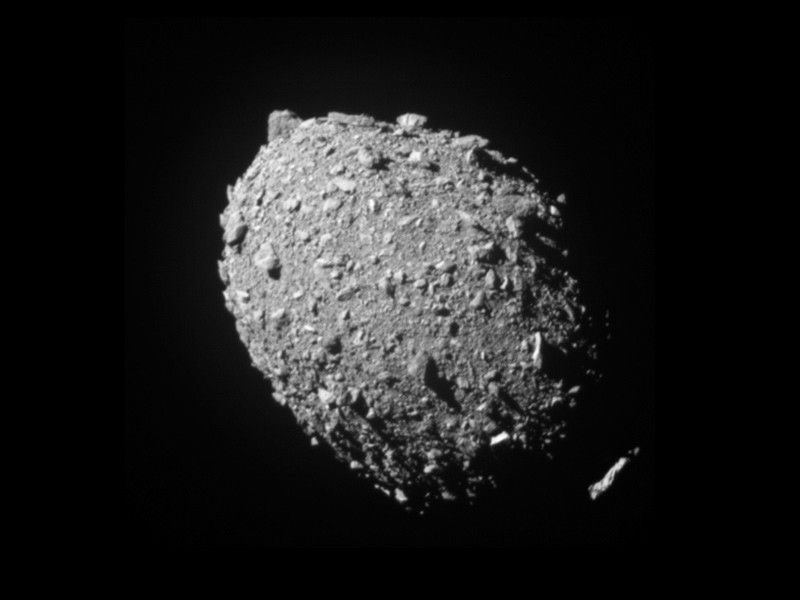
When DART struck Dimorphos, the collision didn’t just transfer momentum through the spacecraft’s mass — it also generated a plume of material knocked off the asteroid’s surface. This debris plume provided additional “push” that helped re‑shape the moonlet’s orbit around Didymos.
Scientists refer to this effect as the “momentum enhancement factor.” Early estimates suggested the effect could account for a 20–30% increase in momentum transfer beyond the spacecraft’s physical impact — a promising outcome for future deflection strategies.
Key Lessons for Future Defense
NASA and international partners collected a treasure trove of data from the DART mission, much of which will inform future planetary defense planning:
-
Improved modeling of asteroid composition and structure. Understanding how different types of asteroids respond to impact forces will be critical for devising effective deflection strategies.
-
Refined measurement techniques. Continued observations of Dimorphos’ orbit help validate theoretical models and improve predictive tools.
-
Engineering insights. The mission provided key lessons on spacecraft design, navigation accuracy, and autonomous targeting in deep space.
These insights not only enhance defensive planning but also contribute to broader planetary science, including understanding how small bodies evolve over time and how collisions shape the solar system.
International Collaboration and Preparedness
The success of DART also highlights the importance of global cooperation in planetary defense. NASA worked closely with space agencies and observatories worldwide to track observations before and after the impact. The European Space Agency’s (ESA) Hera mission — scheduled for launch in late 2024 with arrival near Didymos and Dimorphos in 2027 — will provide follow‑up measurements, including detailed mapping of the impact site and asteroid characteristics.
Hera’s high‑resolution instrumentation will help scientists better understand surface changes, internal structure, and how rocks and debris were re‑distributed after the collision — all critical for refining future defense efforts.
Why It Matters
While no known asteroid currently poses a significant risk to Earth in the near future, scientists emphasize that continued investment in detection and mitigation strategies is essential. More than 28,000 near‑Earth asteroids have been catalogued, and new ones are discovered regularly.
Major planetary defense efforts include:
-
NEO Surveyor Mission. A space telescope designed to detect and track potentially hazardous asteroids.
-
Ground‑based observatories. Networks around the world monitor the sky for moving objects.
-
International coordination. Organizations like the United Nations’ Committee on the Peaceful Uses of Outer Space facilitate collaboration.
The success of DART helps ensure that, if a dangerous asteroid were ever identified, scientists would have at least one proven method to attempt to deflect it — a reassuring development for global safety and space exploration.