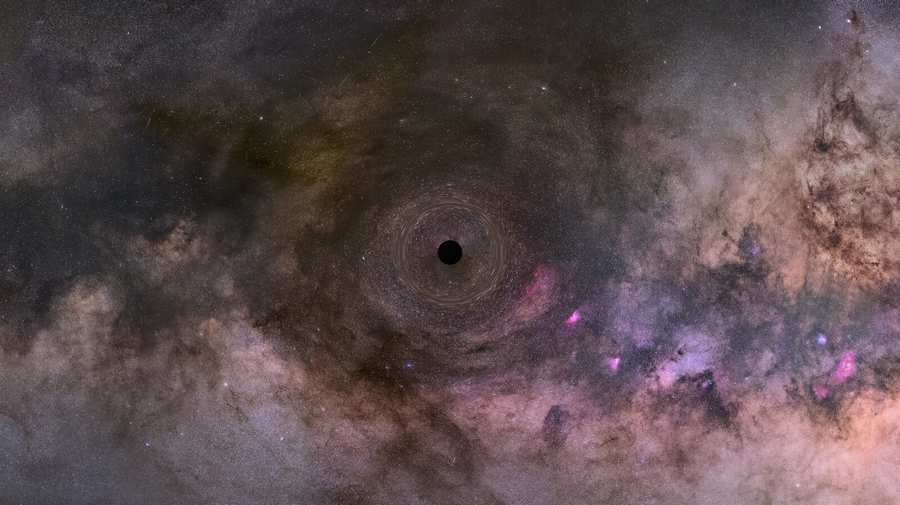
In a development that has cosmologists and astrophysicists buzzing worldwide, researchers are now reporting evidence suggesting a possible detection of a primordial black hole (PBH) — an object thought to have formed in the very first moments after the Big Bang. If confirmed, this finding could fundamentally reshape our understanding of the early universe and the mysterious nature of dark matter.
🔭 What Is a Primordial Black Hole?
Most black holes we observe are born from the collapse of massive stars. Primordial black holes, by contrast, are hypothesized to have formed from extremely dense fluctuations in the swirling hot plasma of the infant universe — fractions of a second after the Big Bang. Unlike their stellar counterparts, PBHs could span a huge range of masses, from microscopic specks to many times the mass of our Sun.
They’ve long been a theoretical possibility in cosmology and are sometimes invoked as a potential contributor — or even explanation — for dark matter, the unseen mass that makes up about 27 % of the universe.
🛰️ The New Signal: Gravitational Waves With a Twist
Scientists working with data from the Laser Interferometer Gravitational-Wave Observatory (LIGO) and other instruments have reported an unusual gravitational wave signal that doesn’t match the typical signatures produced by black hole mergers from dying stars.
This kind of signal could arise if two exceptionally light black holes — potentially primordial in origin — spiraled together and merged deep in the cosmos. Ordinary black holes formed from stars generally have masses above about 3 solar masses, whereas a sub‑solar mass merger would point strongly to a primordial origin.
One of the most compelling parts of this latest research is that the waveform and properties of the signal differ from expectations for conventional stellar collisions. While not yet conclusive, this has led researchers to cautiously suggest the possible detection of a PBH event — a discovery that would be historic in scale and impact.
🧪 Why This Matters
The significance of this potential detection can hardly be overstated:
- Origins of the Universe: Confirmation of a primordial black hole would provide a direct glimpse into conditions in the universe mere fractions of a second after the Big Bang — the earliest epochs of cosmic history.
- Dark Matter Clues: Many models predict that a fraction of dark matter could consist of primordial black holes. If at least some PBHs exist, it could explain part of the mysterious mass that shapes galaxy formation and cosmic evolution.
- New Physics: Traditional particle dark matter candidates (like WIMPs) have evaded detection. A confirmed PBH signal could open entirely new avenues in cosmology and fundamental physics.
📊 How Scientists Are Studying Primordial Black Holes
Researchers employ a range of observational and theoretical techniques:
| Method | What It Reveals |
|---|---|
| Gravitational Waves | Detect signatures of black hole mergers, including possible sub‑solar mass events |
| Pulsar Timing Arrays | Search for low‑frequency gravitational wave backgrounds linked to early universe phenomena |
| Cosmic Microwave Background (CMB) | Look for energy injection patterns influenced by PBHs |
| Microlensing Surveys | Detect light distortions as PBHs pass in front of stars |
| Neutrino Observatories | Examine ultra‑high‑energy neutrinos that might originate from PBH evaporation |
⚠️ Caution: Still Early Days
Scientists emphasize that proof is far from settled. At present, the observed signal is suggestive, not definitive, and alternative explanations — including atypical but conventional astrophysical sources — cannot yet be ruled out. Confirming a primordial origin will require additional detections, cross‑checks, and deeper data analysis from gravitational wave observatories and complementary instruments worldwide.
However, as one team of researchers put it, “This potential discovery could be the first tangible evidence of objects formed in the first moments of the universe — a fossil from the dawn of time.”
🧠 Looking Forward
Ongoing and future upgrades to LIGO, VIRGO, KAGRA, and next‑generation gravitational wave detectors are expected to vastly improve sensitivity to subtle cosmic phenomena, like primordial black hole signals. If additional unusual events are spotted — particularly at masses that cannot be explained by stellar processes — the case for PBHs will grow stronger.
In the coming years, scientists hope to either confirm or falsify these early hints — and in doing so, unlock one of the most profound chapters in cosmic history.