
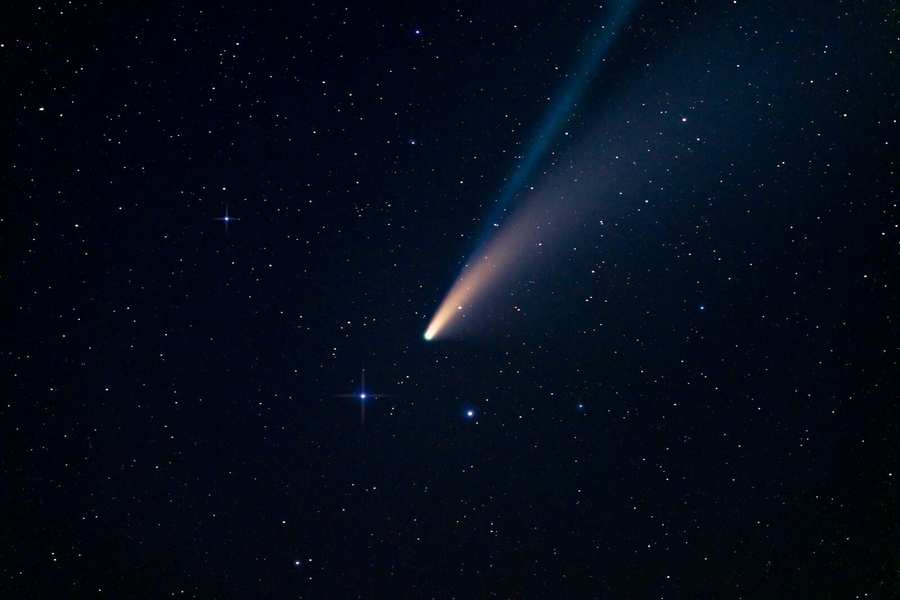
Astronomers around the world are abuzz with new revelations about the mysterious interstellar visitor 3I/ATLAS, suggesting this object may be billions of years older than the Sun and even the entire Solar System itself—offering an extraordinary glimpse into the early history of our galaxy.
🪐 A Rare Visitor From Deep Space
First identified on July 1, 2025 by the Asteroid Terrestrial‑impact Last Alert System (ATLAS), 3I/ATLAS is the third confirmed interstellar object ever observed passing through our Solar System, following ʻOumuamua and 2I/Borisov. Its high‑speed, hyperbolic trajectory indicates it originated from outside our stellar neighborhood and is now on its way back out into deep space after a close approach to the Sun.
📜 An Ancient Cosmic Relic
Recent scientific analysis suggests that 3I/ATLAS may be significantly older than our Solar System (4.6 billion years old)—possibly on the order of 8 to 14 billion years. If confirmed, this would make it one of the oldest objects ever studied by astronomers.
Scientists estimate the comet’s age using models of galactic evolution and isotopic composition, which point to formation in the early Milky Way—likely in the cold, distant environment of the galaxy’s thick disk. This ancient origin implies that 3I/ATLAS formed long before the Sun and planets existed, giving it a unique record of early cosmic chemistry.
🧪 Clues Hidden Within Its Chemistry
Astronomical observations, including James Webb Space Telescope (JWST) data, reveal that the comet’s composition is unusual compared to typical Solar System comets. High levels of carbon dioxide and rare isotopic signatures—such as deuterium enrichment—suggest that 3I/ATLAS formed in an exceptionally cold and chemically distinct environment. These chemical fingerprints support the idea that the object is not only interstellar but also very ancient.
Such isotopic patterns are key: they act like a cosmic timestamp, revealing conditions in the early universe and offering insights into how planetary systems may form around other stars.
📊 Why This Matters to Science
| Feature | Implication |
|---|---|
| Age (~8‑14 billion years) | Older than the Sun and Solar System |
| Hyperbolic orbit | Origin from outside our Solar System |
| Unusual chemistry | Insights into early galactic conditions |
| Interstellar origin | Rare sample of another star system’s building blocks |
3I/ATLAS provides a once‑in‑a‑lifetime opportunity for researchers to study matter that formed in completely different cosmic environments, billions of years before our Sun ever existed. These data could reshape theories of planet formation and galactic evolution.
🔭 What’s Next for Observations
Although 3I/ATLAS has already passed its closest point to the Sun and Earth, astronomers continue to track and analyze the object as it recedes back into interstellar space. Advanced telescopes both on Earth and in orbit are collecting data on its tail composition, dust emission, and spectral signatures—each offering additional pieces of the ancient cosmic puzzle.
Scientists also plan to compare 3I/ATLAS’s data with future interstellar visitors to better understand the diversity of objects wandering through our galaxy.
🌠 A Glimpse Into the Cosmic Past
Whether or not 3I/ATLAS turns out to be the oldest comet ever seen, it stands as a remarkable bridge to the early Milky Way—a fragment of ancient stellar systems, carrying the chemical heritage of our galaxy’s formative years. Studying this interstellar wanderer could deepen humanity’s understanding of how stars and planets form across the universe.